Pressure Washer Hose Buyers Guide
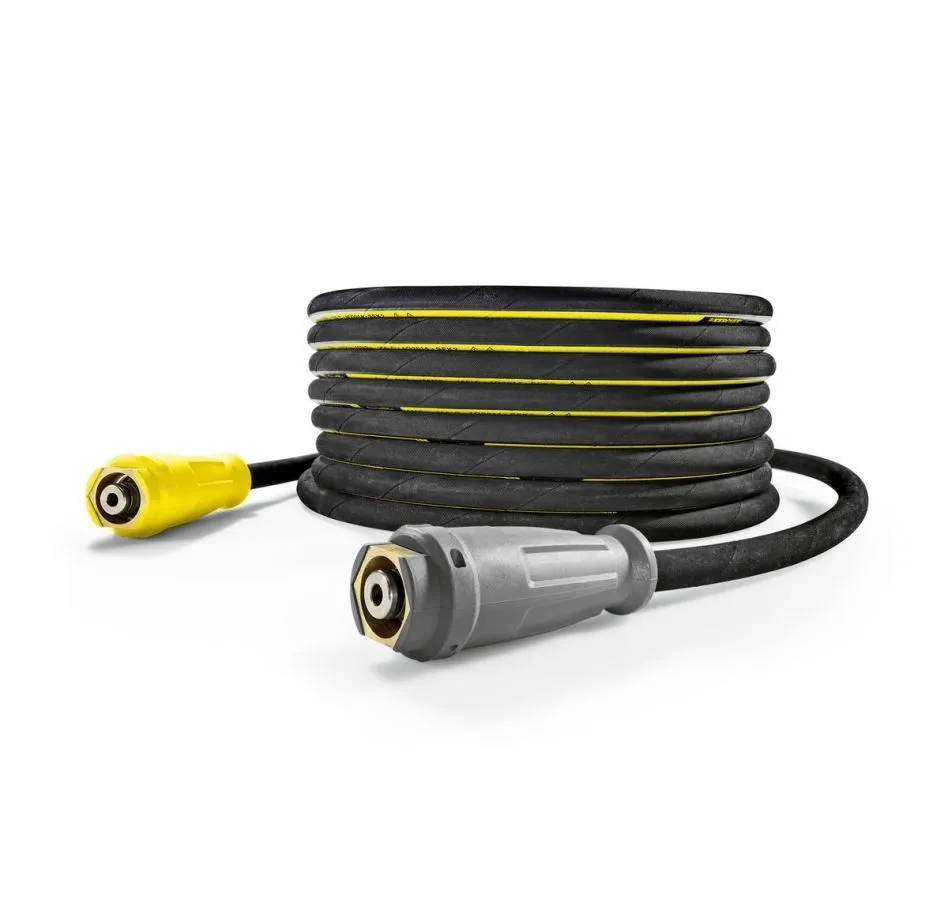
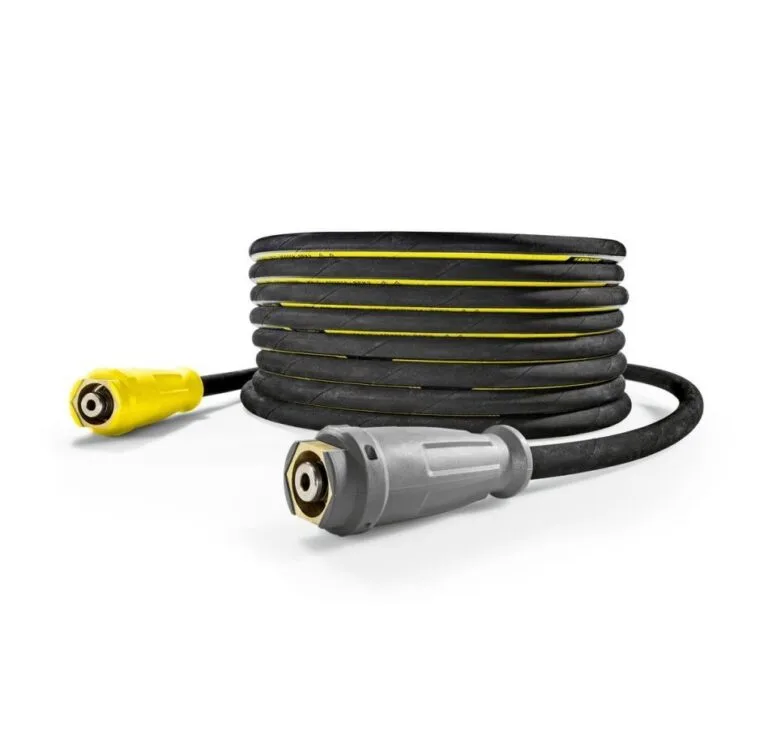
Choosing a pressure-washer hose involves more than selecting the right length. The hose must match the machine’s pressure, water temperature, flow rate, connector type, and intended cleaning application.
A hose that is too small may restrict water flow, while an underrated hose can fail under pressure. The wrong fittings can also create leaks or prevent the hose from connecting to the pump, spray gun, or existing accessories.
This pressure washer hose buyer’s guide explains how to compare diameter, length, material, PSI, temperature rating, and connectors. It also covers residential and commercial applications, common compatibility problems, and signs that an old hose should be replaced.
Understanding Pressure Washer Hoses
A pressure washer hose is a flexible hose that provides an attachment point between the pressure washer pump and the spray gun. Its purposes include creating a high pressure produced by the washer and feeding it to the spray gun. The hose must also be of the capacity to handle pressure and the extreme conditions being applied during the process of pressure washing.
Why is the Right Hose Important?
To get the best out of your pressure washer, it is important that you use the right hose. An improper selection of hose results in low efficiency, risk of damaging the washer, and even posing a threat to the user’s safety. A good hose can help you in almost every cleaning task you may have, make sure the hose doesn’t leak and that water pressure is consistently strong.
Quick Pressure Washer Hose Selection Chart
| Cleaning Requirement | Suggested Hose Type | Common Consideration |
| Light residential cleaning | 1/4-inch hose | Confirm PSI and connector compatibility |
| Medium-duty cleaning | 5/16-inch hose | Balance flexibility and water flow |
| Commercial pressure washing | 3/8-inch hose | Select for higher flow and continuous use |
| Hot-water cleaning | Hot-water-rated hose | Confirm maximum temperature |
| Vehicle or fleet washing | Flexible, non-marking hose | Protect painted surfaces |
| Construction or industrial use | Steel-braided, abrasion-resistant hose | Designed for rough operating conditions |
| Food-related cleaning | Application-approved hose | Confirm material and sanitation requirements |
| Large properties | Longer commercial hose | Consider weight, storage and pressure loss |
These are general categories. Buyers should confirm the equipment manufacturer’s required inside diameter, working pressure, temperature, fittings, and flow capacity.
Key Factors to Consider
Material
- Rubber: Flexible with relatively high tensile strength, and resistant to kinks and other forms of mechanical damage. Meant for commercial operations but it is slightly heavier and more costly than the other type. True rubber hoses have higher pressure ratings and are more abraded.
- PVC: These PVC hoses are suitable for infrequent use as well as tasks that do not require much friction between surfaces.
- Polyurethane: They are more expensive than the heavy-weighted ones. These hoses are suitable for a fairly broad array of tasks and may be somewhat easier to manage as well.
- Hybrid: In most cases, the combination of rubber and PVC makes these hoses very strong and easily adjustable like rubber but with the firm strength of PVC.
Length
Pressure washer hoses are available in different lengths and normally provide pressures ranging from 20 to 100 feet. The right length of a pressure washer hose depends on the cleaning tasks you have and the space to be covered. This gives a larger working radius as the hoses are longer but will slightly affect the water pressure due to the longer distance the water needs to travel. Estimate the distance from your cleaning area to your water sources while deciding on the length of the hose.
Hose Diameter
The hose’s inside diameter affects water flow and equipment compatibility. Selecting a hose based only on its outside appearance may result in restricted flow or poor performance.
| Inside Diameter | Common Application | Main Consideration |
| 1/4 inch | Light-duty residential machines | Lightweight but limited for higher flow |
| 5/16 inch | Medium-duty pressure washers | Balances flexibility and flow |
| 3/8 inch | Commercial and industrial equipment | Supports higher flow but weighs more |
The correct diameter depends on the machine’s GPM, PSI, hose length, and fittings. A 3/8-inch hose is common for commercial applications, but it should not be treated as universally compatible with every pressure washer.
Connection Types
- Quick Connect: The most convenient and quickest to join and disengage from a surface.
- Threaded: Offers initial protection during the connection process but takes a longer time to establish a connection.
- M22: When selecting the hoses, confirm that they fit your pressure washer and all the connected accessories in terms of compatibility.
How to Check Hose and Fitting Compatibility
Before purchasing a hose, inspect the connections at the pressure-washer outlet and spray gun. Connector style, thread size, and internal diameter must match the equipment.
Common connection systems include:
- M22 threaded fittings
- 3/8-inch quick-connect fittings
- Proprietary manufacturer connections
- Swivel and anti-twist fittings
- Kärcher EASY! Lock connections
“M22” does not always guarantee a match because connector dimensions can vary. Do not force incompatible fittings together or rely on an adapter without checking its PSI, temperature, and flow ratings.
When replacing a hose, record the machine model, maximum PSI, GPM, water temperature, and fitting type. This information makes it easier to identify a suitable replacement.
Performance and Durability
Pressure Rating
Pressure washer hoses are rated by their PSI (pounds per square inch). Pick a hose that has a PSI of one or two points more than that of your pressure washer. When employing a hose with a smaller rating, chances are the hoses will burst and the entire system may be affected.
Working Pressure vs. Burst Pressure
Working pressure is the maximum pressure the hose is designed to handle during normal operation. Burst pressure represents the pressure at which the hose may fail under test conditions. Buyers should select a hose according to its working-pressure rating, not its burst-pressure figure.
The hose’s rated working pressure should meet or exceed the pressure washer’s maximum output. Saying that it should be only “one or two points higher” is incorrect because PSI ratings are measured in hundreds or thousands of pounds per square inch.
Every fitting, coupler, spray gun, and accessory should also support the machine’s operating pressure.
Temperature Resistance
Depending on the intended purpose, some hoses are for hot water use while others are meant to be used with cold water only. Hot water hoses are designed to handle higher temperatures therefore ideal during greasy surface washing.
Flexibility and Kink Resistance
A flexible hose is easier to maneuver, especially around objects than a rigid hose, and chances of getting kinks that hinder the water flow are eliminated. Choose the hoses which are kink-resistant to handle, as the name suggests it will not be easy to develop twists on them. Usage flexibility is especially helpful when a hose is employed to clean larger or more intricate areas, such as an L-shape area.
Abrasion Resistance
Hoses with high abrasion usually resist rubbing on the surface and dragging across the ground which increases the lifespan of the hose. This hose is perfect when used for a situation that involves dragging it on concrete or gravel which are abrasive surfaces.
Can a Cold-Water Hose Be Used With Hot Water?
A cold-water hose should not be used with a hot-water pressure washer unless its specifications confirm that it can handle the machine’s maximum temperature. Excessive heat can soften the hose, damage its inner tube, weaken fittings, and shorten its usable life.
Hot-water hoses are designed with materials and reinforcement suitable for elevated temperatures. When selecting one, compare both the continuous and maximum temperature ratings with the pressure washer’s output.
Does a Longer Pressure Washer Hose Reduce Pressure?
A longer hose can create additional friction and may reduce performance, particularly when the inside diameter is too small for the machine’s GPM. However, a properly sized commercial hose can provide additional working range without causing a major practical loss.
Consider these factors before extending hose length:
- Machine PSI and GPM
- Hose inside diameter
- Total hose length
- Number of fittings and adapters
- Required working radius
- Weight and storage
- Whether the operator needs a hose reel
Which Hose Material Should You Choose?
| Material | Advantages | Limitations | Best Application |
| PVC | Lightweight and affordable | Stiffer and more likely to retain coil memory | Occasional residential cleaning |
| Rubber | Flexible and abrasion resistant | Heavier and may mark some surfaces | Commercial cleaning |
| Polyurethane | Lightweight and flexible | Often more expensive | Frequent movement and portability |
| Hybrid polymer | Balances flexibility and weight | Quality varies by product | Residential and light-commercial work |
| Steel-braided hose | Strong reinforcement for demanding use | Heavy and less convenient to move | Industrial and high-pressure applications |
The best material depends on how often the hose will be used, where it will be dragged, and whether the cleaning environment includes heat, oil, chemicals, or abrasive surfaces.
Pressure Washer Hoses for Different Cleaning Needs
Discover which hoses stand out for their durability, flexibility, and overall performance, ensuring you can tackle any cleaning challenge with ease.
-
-
-
-
-
-
-
-

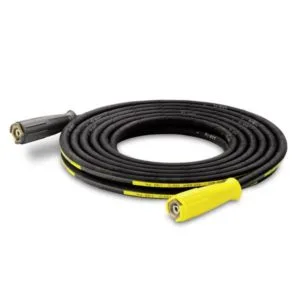
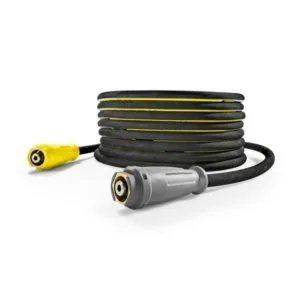
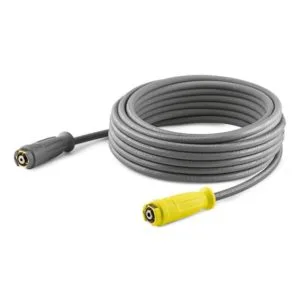
100ft Karcher Twist-Type Hose
The 100ft Karcher Twist-Type Hose is made for high-pressure cleaning. It has adjustable 22mm female anti-kink threaded ends to handle high-pressure cleaning with ease. It has 22mm female anti-kink threaded ends. The yellow endpoints at the full 360-degree swivel provided for the monitor. This hose is designed to allow easy movement in wide areas without frequently requiring change in positions hence making a great reach.
- Pros:
- Built specifically for Karcher models, which guarantees that it will work properly with the equipment.
- 22mm female anti-kink threaded ends
- 360° swivel capacity
- Easy to attach and detach and they are installed in an instant without requiring much effort.
- Cons:
- Compatible only with Karcher pressure washers, not a one-size-fits-all solution.
Simpson Cleaning 40223 Pressure Washer Hose
The Simpson Cleaning 40223 is a tough and versatile high-pressure hose meant for use in heavy-duty cleaning jobs. This particular hose has a working pressure of up to 4,000 PSI and its length is 50 feet, so it can be used in both home and office space. It has a strong structure with the necessary protection against kinking and abrasion, which guarantees a constant supply of water.
- Pros:
- Capacity to work under pressure – 4,000 PSI
- Resilient styles that practically don’t twist.
- Long arm length of 50 feet in extent to achieve more distance.
- Cons:
- May be excessive if used for cleaning less complicated surfaces.
- Sluggish than some of the lightweight hoses.
Flexzilla Pressure Washer Hose
The Flexzilla Pressure Washer Hose is famous for being lighter and more flexible, which is very advantageous when utilized during cleaning processes. This hose comes with a 3/8” diameter and is compatible with high pressures of up to 3000 PSI. Its polymer material does not kink or tangle, which makes the water flow smoothly without interruptions. It can be ordered in different sizes, so it suits any house and even some commercial premises.
- Pros:
- Easy to maneuver by is lightweight and flexible.
- Resists kinking and tangling
- Available in multiple lengths
- Cons:
- May not be as suitable for very high pressure applications as some of the denser hoses.
- Somewhat costlier than conventional rubber hoses
Sun Joe SPX-HOSE-50 Pressure Washer Hose
The Sun Joe SPX-HOSE-50 is a 50-foot replacement hose designed for compatibility with a wide range of pressure washer models. It offers a durable construction that can handle up to 2,000 PSI, making it suitable for light to medium-duty cleaning tasks. The hose is easy to install and features quick-connect fittings for hassle-free use.
- Pros:
- Compatible with many models, enhancing versatility
- The 50-foot length provides good reach
- Easy installation with quick-connect fittings
- Cons:
- Limited to a 2,000 PSI capacity
- May not be suitable for heavy-duty applications
Briggs & Stratton 6188 Pressure Washer Hose
The Briggs & Stratton 6188 is a reliable replacement hose that offers exceptional performance and durability. With a length of 30 feet and a pressure rating of up to 2,700 PSI, this hose is designed to fit most gas-pressure washers. Its heavy-duty construction is resistant to abrasions, ensuring longevity and consistent performance during use.
- Pros:
- Compatible with most gas-pressure washers
- Abrasion-resistant for durability
- The 30-foot length offers reasonable reach
- Cons:
- A shorter length may limit the cleaning range
- Not suitable for extreme high-pressure applications
When Should You Replace a Pressure Washer Hose?
Replace the hose when you find:
- Cuts, cracks, or exposed reinforcement
- Bulges or soft areas
- Leaks or pinholes
- Damaged or corroded fittings
- Severe abrasion
- Permanent kinks
- Heat damage
- Separation near the connectors
Do not patch a high-pressure hose with tape, glue, or an ordinary hose-repair kit. Pressure-washer manuals commonly instruct operators to replace damaged high-pressure hoses rather than repair them.
Conclusion
The right hose must match the pressure washer’s PSI, GPM, temperature, connector type, and intended application. Length and material also affect maneuverability, durability, and storage.
Residential users may prioritize a lightweight, flexible hose, while contractors, fleet operators, and industrial facilities often need larger-diameter hoses with stronger reinforcement and higher temperature ratings.
Pressure King supplies pressure-washer hoses, accessories, replacement parts, and equipment support for customers throughout New Jersey. Contact Pressure King with your pressure-washer model and operating requirements for help identifying a compatible hose.
FAQs
What size pressure washer hose do I need?
Light-duty machines commonly use 1/4-inch hoses, while commercial equipment often uses 3/8-inch hoses. The correct size depends on the washer’s PSI, GPM, fittings, and manufacturer requirements.
Can I use any hose with my pressure washer?
No. The hose must match the equipment’s pressure, temperature, flow, and connector requirements. An incorrect hose may leak, restrict performance, or fail during use.
Is a 50-foot or 100-foot pressure-washer hose better?
A 50-foot hose is generally easier to move and store. A 100-foot hose provides more reach but adds weight and friction. Choose according to the working area and machine flow.
Can I connect two pressure washer hoses?
Compatible hoses may sometimes be joined with correctly rated fittings. However, added connections introduce possible leak points and may affect performance. One properly sized hose is usually the better option.
Can a leaking high-pressure hose be repaired?
A damaged high-pressure hose should be removed from service and replaced. Tape, glue, and ordinary repair fittings are not suitable for components carrying high-pressure water.

Michael Adeniran is the CEO of Pressure King Inc. He has been dealing in commercial cleaning equipment for many years. He is one of the leading specialists and experts in commercial cleaning products.